

The short answer
It usually isn't your product. AI engines recommend the companies they can describe with confidence: brands that are easy to read, explained clearly on their own site, and mentioned consistently across sources the engines trust. If your competitor shows up in more of those places, they get named and you don't.
Key takeaways
- AI engines recommend the brands they can describe with confidence.
- Mentions, clear category labels, and consistent facts drive who gets named.
- The sources cited in your competitor's answers are your outreach list.
Ask ChatGPT for the best tools in your category. If the answer lists three competitors and skips you, that's not a glitch. It's a mirror of what the web says about you, and what it doesn't.
That mirror matters more every quarter. In G2's March 2026 survey of 1,076 B2B software buyers, 51% said they now start research with an AI chatbot more often than with Google, up from 29% a year earlier.1
of B2B software buyers chose a different vendor than they originally planned because it appeared in a chatbot's recommendation.
Source: G2, The Answer Economy, April 2026 [1]How do AI engines decide who to recommend?
They search, then they summarize. The answer can only be built from what they find and can read.
When a buyer asks a complex question, Google's AI Mode and AI Overviews may run several related searches across subtopics, then pull supporting pages into the response. Google calls this query fan-out.2 ChatGPT and Perplexity follow the same basic pattern when they search the web: retrieve sources, then write an answer from them.
So the useful question isn't "does the AI like us?" It's "when the engine goes looking, what does it find about us, and how clearly does it say what we do?"
Why does your competitor show up and you don't?
In our experience it comes down to five gaps. Most companies have at least two.
- They get mentioned in more places. Ahrefs analyzed 75,000 brands and found branded web mentions had the strongest correlation with appearing in Google's AI Overviews (0.664), well ahead of backlinks (0.218).3 Ahrefs is clear that correlation isn't causation. The pattern still holds: brands that get talked about get named.
- Their category is clearer. If your homepage says "the operating system for modern teams" and theirs says "SOC 2 compliance automation for SaaS," only one of you matches the buyer's question.
- Their facts are consistent. Same one-line description on their site, LinkedIn, review profiles, and press. If you describe yourself three different ways, an engine can't place you with confidence.
- Their pages answer questions directly. Comparison pages, pricing, and plain explainers give engines something to quote. In the KDD 2024 study that coined the term GEO, adding citations, quotations, and statistics to content raised its visibility in generative answers by up to 40% in testing, while keyword stuffing didn't help.4
- You're hard to read. Blocked crawlers, copy locked in images or scripts, and key facts buried in PDFs. Google says a page must be indexed and eligible to show a snippet to appear as a supporting link in its AI features, and recommends keeping important content available as text.2
| Signal | What the engine sees | What to fix |
|---|---|---|
| Mentions | Your competitor in reviews, press, and comparisons. You on your own site only. | Earn mentions on the sources engines already cite for your category. |
| Category | A clear label for them. A slogan for you. | One plain sentence: what you are, who it's for. |
| Consistency | Matching facts for them. Conflicting descriptions for you. | Align your site, LinkedIn, and every profile that describes you. |
| Answers | Direct, quotable pages for them. Feature lists for you. | Answer-first pages for the questions buyers ask. |
| Access | Clean, indexable text for them. Gaps for you. | Check crawling, indexing, and text-based content. |
Table 1. What the engine sees, and what to fix.
Don't write it off as AI being "biased" toward bigger brands. Size helps because big brands get mentioned more. Mentions can be earned.
How do you change the answer?
You don't need a bigger budget. You need a clearer, more consistent footprint in the places engines look.
Run your buyers' questions
List the ten questions your best customers asked before they bought. Ask each one in ChatGPT, Perplexity, Gemini, and Google AI Mode. Note who gets named and which sources get cited.
Remove the blockers
Confirm your key pages are crawlable and indexed, and that your positioning lives in on-page text, not only in images.
Write your one-line description, then use it everywhere
Category, audience, and one proof point. Put the same line on your site, LinkedIn, and review profiles.
Publish the pages buyers ask about
Comparisons, alternatives, pricing, and use cases, each opening with a direct answer.
Earn mentions where engines look
Start with the sources cited in step 1: review sites, industry press, partner pages, podcasts, and your founder's LinkedIn.
The sources cited in your competitor's answers are your outreach list. Start there.
New to the terms? Start with AEO, GEO, and SEO: what's actually different? Next up: how ChatGPT search chooses its sources.
The bottom line
AI search doesn't reward the loudest company. It rewards the one it can describe most clearly, from the most places. That's a gap you can close.
Sources
- G2, In the Answer Economy, Don't Win the Click, Win the Answer, April 15, 2026. Survey of 1,076 B2B software buyers, March 2026; 2025 comparison figure from G2's 2025 Buyer Behavior Report (company.g2.com/news/buyer-behavior-in-2025). company.g2.com/news/g2-research-the-answer-economy
- Google Search Central, AI features and your website, last updated December 10, 2025. developers.google.com/search/docs/appearance/ai-features
- Ahrefs, An Analysis of AI Overview Brand Visibility Factors (75K Brands Studied), May 26, 2025. ahrefs.com/blog/ai-overview-brand-correlation/
- Aggarwal et al., GEO: Generative Engine Optimization, KDD 2024. arxiv.org/abs/2311.09735
About the author
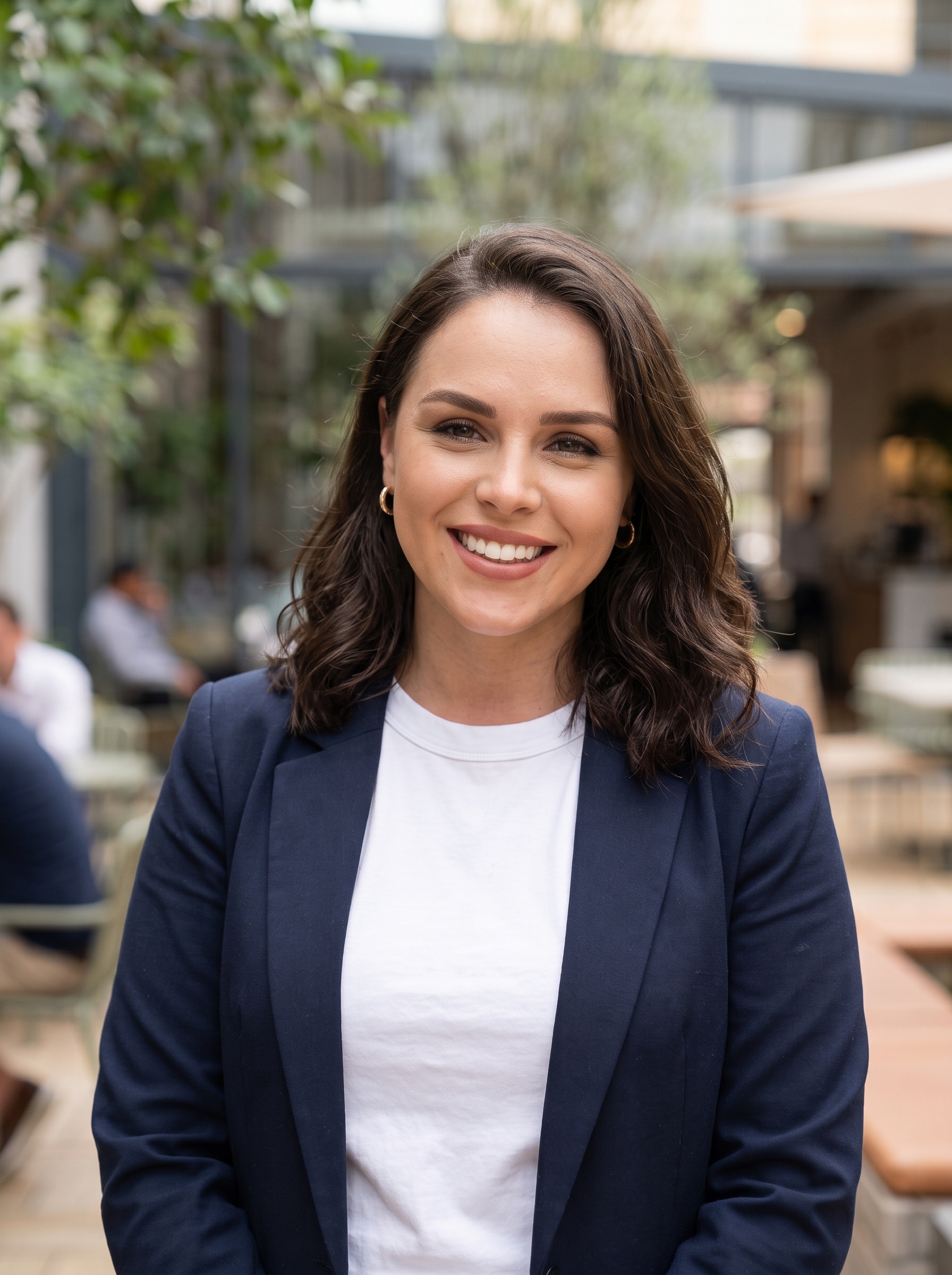
Aimee van der Haar
Aimee founded Bearly Creative to give great startups and tech companies the marketing they deserve. She works across strategy, design, content, and AI search, and she still does the work herself.